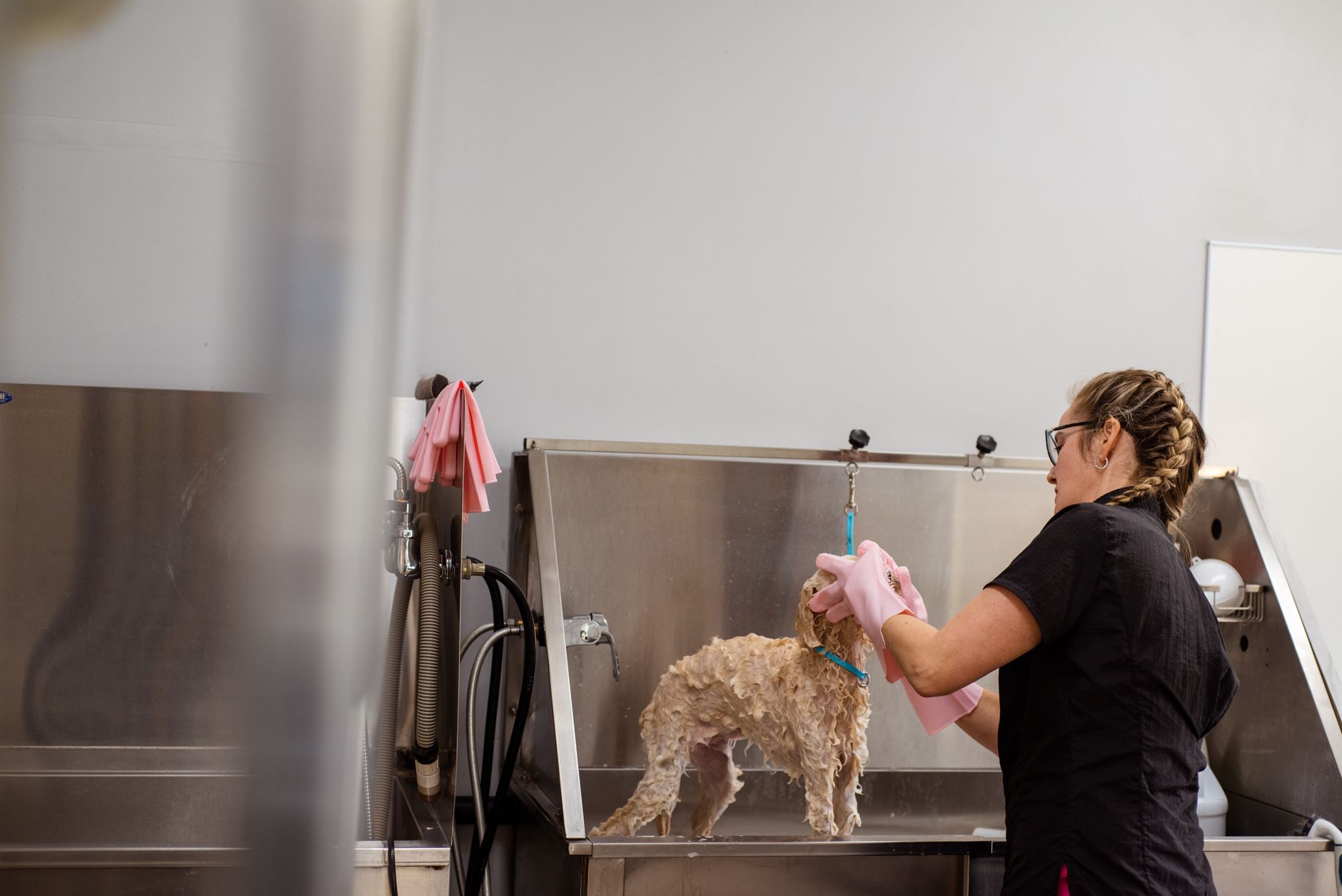
If you run a grooming salon, a mobile grooming van, or a dog-walking round, your day already starts before most people have finished their coffee — and it usually ends with a spreadsheet, a WhatsApp backlog, and a stack of receipts you meant to log on Tuesday. AI is not going to walk the dogs for you. But in 2026 it can quietly take about a day a week off your plate: the enquiry replies, the booking reminders, the social posts, the invoices, the "which brush suits a Cockapoo in moult" questions from new clients.
This guide is a plain-English playbook for independent pet-care businesses. No hype, no "AI will disrupt the pet industry" nonsense — just the specific workflows that are working right now for one-person mobile groomers, three-chair salons, and small dog-walking rounds, plus a tool stack you can put together for well under £100 per month.
What a typical week looks like — and where AI actually helps
Before we talk about tools, it is worth being honest about where the hours actually go. When we speak to groomers and walkers, the pattern is almost always the same. Two to three hours a day disappear into WhatsApp and Instagram DMs. Another hour vanishes into rebooking, rescheduling, and chasing deposits. Weekends get eaten by social content, invoices, and the endless "just checking if you have space for Bella on Thursday" thread.
AI is genuinely useful for the admin edges of this business — the parts you do not enjoy and do not get paid for. It is much less useful for the craft itself. No language model is going to hand-strip a wire-haired Dachshund or read a nervous rescue dog the way you do. Keep that in mind as you read on: the goal is to reclaim the two hours around the appointments, not to replace the twenty minutes inside them.
Five AI workflows worth setting up first
These five workflows are the ones that pay for themselves fastest. You do not need to do all of them. Pick the one that annoys you the most and start there.
1. First-reply autoresponder for new enquiries
Most new grooming and walking enquiries arrive by Instagram DM, Facebook Messenger, or a website form. The client who books is almost always the one who got a reply within the hour. An AI-drafted first reply — pulled from your prices, availability windows, and a short list of qualifying questions (breed, coat condition, temperament, postcode, vaccination status) — can be sent in one tap from your phone. You still read it, tweak it, and send. But you do not stare at a blank text box between clips.
2. Smart rebooking and no-show reminders
Every experienced groomer knows the maths: a client who rebooks on the day walks out at 6-week intervals; a client who "will ring next month" often waits 12 weeks or drifts to a competitor. AI can draft warm, personalised rebooking messages ("Hi Sam — Bella is due her next tidy the week of the 4th, would Thursday morning work?") based on the last visit and the coat type. Same for no-show prevention: a 24-hour reminder that mentions parking, arrival time, and a photo from last time gets replies. A generic "you have an appointment tomorrow" does not.
3. Social content in ten minutes a week
You already take photos of every dog. AI can turn those into a week's worth of captions, alt text, and hashtags — in your voice, not in the AI's — from a short prompt and a batch of images. For dog walkers, the same trick works for weekly "pack updates" that reassure owners and quietly market to their neighbours.
4. Client-brief cheat sheets before each visit
For groomers with growing books, remembering that Milo hates having his back paws done and that Coco's owner tips well but always runs 15 minutes late is the difference between a good day and a chaotic one. A short AI-generated pre-visit brief — pulled from your notes, last invoice, and any photos — is a game-changer for a two- or three-groomer salon.
5. Invoices, receipts, and the tax return you keep pushing to Sunday night
AI-powered bookkeeping tools now handle photo-in, categorised-transaction-out in seconds. For a sole-trader groomer or walker, this is often the single highest-ROI workflow: an hour a week saved and a bookkeeper's bill cut in half at year-end. If you want to size this properly for your business, our guide on how to calculate the ROI of AI implementation shows the maths.
A tool stack by business size
You do not need enterprise software. Pick the row that matches you.
Solo mobile groomer or one-round dog walker
Total spend: roughly £30–£45 per month.
- ChatGPT Plus or Claude Pro (£17–£20/month) for enquiry replies, captions, rebooking messages, and general "help me word this" moments. If you write a lot, Claude edges it; if you also want images and voice on the go, ChatGPT wins. Our Claude vs ChatGPT comparison goes deeper.
- A simple booking tool with SMS reminders (Setmore, Fresha, or Pawfinity — £0–£20/month depending on plan). Native reminder templates cut no-shows before AI touches them.
- A bookkeeping app with AI receipt capture (FreeAgent, QuickBooks Self-Employed, or Xero Starter — £10–£15/month). Photograph the fuel receipt, get on with your day.
Two- to five-person grooming salon
Total spend: roughly £80–£140 per month.
- ChatGPT Team or Claude Team (£24–£28 per seat per month) for the owner and one senior staff member — with data-isolation and shared prompt libraries so everyone replies to enquiries in the same voice.
- An AI-first inbox layer like Superhuman AI or a shared WhatsApp Business account with an AI drafting assistant, so DMs do not pile up on one person's phone.
- A proper booking and CRM system (Pawfinity, Groomsoft, or Fresha) — the AI value only shows up if the client history and coat notes are actually in one place to summarise.
- A social scheduler with AI captions (Buffer AI Assist, Later, or Metricool) — £15–£30/month.
Multi-van dog-walking business (5+ walkers)
Total spend: roughly £120–£200 per month.
- Team AI plan as above, plus a lightweight ops workspace (Notion AI or ClickUp AI, £8–£15 per seat) for shift handovers, walker check-ins, and incident notes.
- A route-optimisation tool (Circuit for Teams, OptimoRoute) — technically AI-adjacent, but the fuel savings alone usually pay the whole stack.
- An AI meeting-notes tool (Fathom, Fireflies, tl;dv, £0–£19/user) for the weekly walkers' huddle, so nobody is scribbling actions on the back of a lead.
Prompts you can copy and use today
Save these in a note on your phone. Swap the words in square brackets. All three assume you have already told the AI, once, who you are and how you speak ("I'm a mobile groomer covering north Bristol, my tone is warm and practical, I speak in British English, I never use exclamation marks, my prices are…").
New enquiry reply:
Draft a warm, concise reply to this new grooming enquiry. Ask for breed, coat condition, last groom date, and postcode. Mention my next two available slots [Tue 10:00, Wed 14:00] and my standard price for a [medium-coat] dog [£55]. Keep it under 90 words. No exclamation marks.
Rebooking nudge (batch of clients):
Here is a list of clients due for their next groom in the next fortnight [paste name, dog name, breed, last visit date, last service]. Draft a short, personal message to each in my voice. Reference the dog by name. Offer one specific slot. No pressure. British English.
Weekly social batch:
Here are five photos from this week's grooms/walks [paste alt-text descriptions]. Write five Instagram captions in my voice — short, warm, no clichés, one line of copy plus 3–5 relevant local hashtags for [your town]. Add one gentle call to action to DM for the September slots.
The 30-day pilot: what to try, what to measure
Do not roll out five workflows at once. Pick one, pilot it for four weeks, measure honestly, then add the next.
- Week 1 — set-up. Choose one workflow (enquiry replies is the usual winner). Pick one AI tool. Write down your baseline: how many new enquiries you got last week, how many replied within an hour, how many booked.
- Week 2 — daily use. Use the AI draft for every enquiry, every day. Keep a note of every time you had to heavily rewrite it — those are your prompt-improvement opportunities.
- Week 3 — refine. Update your prompt with the tweaks from Week 2. Add three example replies you loved to a "gold standard" note the AI can reference.
- Week 4 — measure. Compare the same numbers against your baseline. Reply-within-an-hour rate, booking conversion rate, and — the honest one — how many evenings you got back.
If the numbers moved and you feel calmer, layer in the next workflow. If they did not, do not double down — try a different workflow before you spend more on tools.
Common mistakes pet businesses make with AI
A few patterns come up again and again in this industry. Avoiding them will save you weeks.
Sounding like every other salon. If you never edit the AI's first draft, you will start to sound identical to the salon down the road that also never edits its first draft. Your voice is your marketing. Always read before you send.
Auto-booking without a human check. Some tools now offer to accept bookings directly from an AI chat. For grooming this is risky — a Cockapoo in matted coat needs a longer slot than the system will guess. Let AI draft and qualify; let a human confirm the slot for now.
Ignoring data protection. Client addresses, keys for house calls, and vet contacts are personal data. Use a paid Team plan (which contractually will not train on your inputs), not a free consumer account. For the wider picture on UK/EU rules, our EU AI Act guide for small business covers what you actually need to worry about.
Betting the business on one tool. If your entire client comms lives inside one AI-first inbox and it goes down for two days, so do you. Keep client contact details exported monthly to a plain spreadsheet. This is the single cheapest bit of resilience you can build in.
Where AI fits in the bigger picture
Pet businesses are, at heart, trust businesses. Owners hand over the most-loved thing in their house and expect it to come back happy and in one piece. AI does not change that equation. What it changes is how much of your week you spend on everything except the animals — and how quickly you reply to the anxious first-time client at 9pm on a Sunday deciding whether to book you or the salon three streets over.
Used well, AI in 2026 is not a growth hack for pet-care businesses. It is a quiet, boring, compounding advantage: slightly faster replies, slightly warmer reminders, slightly tighter books, evenings that feel like evenings. Over a year, those small edges are the difference between a stressed sole trader and a calm two-chair salon with a waiting list.
If you want a wider view of what a sensible AI stack looks like for a small service business, the best AI tools for small business in 2026 guide places these pet-specific choices in the broader landscape.
Where does your business stand on AI?
Take the free 3-minute AI Readiness Quiz and get a personalised score with your next steps.
Take the Free Quiz →